Optimistic Anarchism 2.0: Scaling Personal Anarchy into Adaptive Anarchy
Decentralized Order in an Age of Overreach

Civilization mistook centralization for order. The older truth is simpler: order appears wherever humans coordinate without permission.
I. The Old Lie of Order
Modern people inherit a superstition: that order descends from authority.
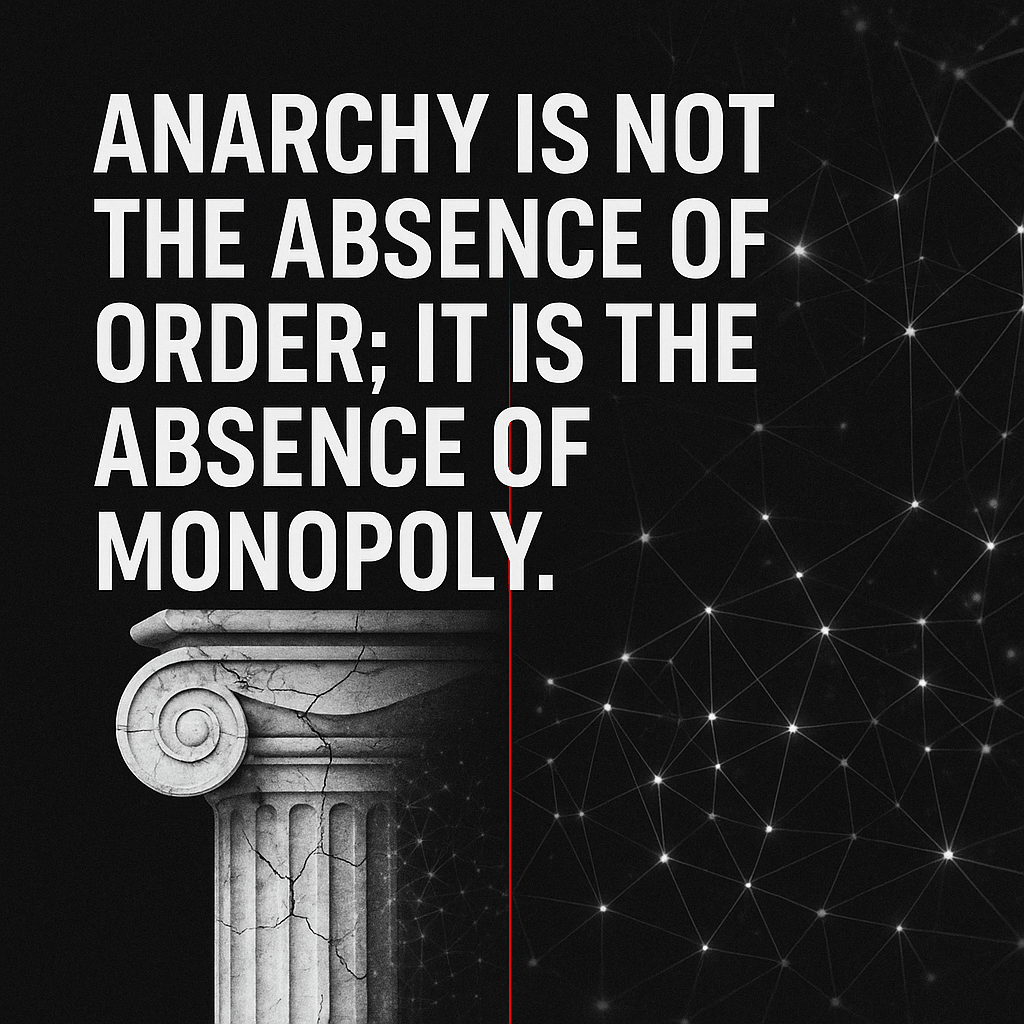
We’ve been trained to see stability as something bestowed—charters, flags, marble buildings, and committees promising peace through hierarchy. The myth flatters both the rulers and the ruled: obey, and the system will keep you safe.
It’s a half-truth at best.
What we call law and order is a narrow, expensive form of order—a paid performance, not the natural rhythm of human cooperation. Look closer, and you’ll find that the world already runs on anarchy: not chaos, but coordination without a throne.
Between nation-states? Anarchy. Between corporations, cartels, and spy agencies? Anarchy again. They coexist by negotiation, deterrence, and reputation, not by submission to a single sovereign. The pattern is universal, ancient, and quietly functional.
The shock isn’t that anarchy exists—it’s that the word itself was captured, demonized, and sold back to us as fear. Yet what it actually names is the oldest form of order known to man.
Anarchy is not disorder. It is order without monopoly.
II. Three Names for One Pattern
Language needs handles, so let’s name the three layers of this decentralized architecture.
They’re not ideologies—they’re scales of one living system.
Anarchy is order that emerges spontaneously when coordination is voluntary. Language, markets, and science all evolved this way—no committees, no kings, no final arbiter.
Personal Anarchy (PA) is that order within the individual: competence, discretion, mobility, the small-scale rituals of self-rule.
Adaptive Anarchy (AA) is what happens when those individuals link up—when many nodes of voluntary order form a mesh that learns faster than hierarchies can legislate.
Seen clearly, all three are variations on the same principle: systems that grow by consent, not coercion.

III. Enforcement Zones: Expensive Illusions
If spontaneous order is so pervasive, why do states, corporations, and bureaucracies dominate the stage?
Because monopolies amplify authority by raising the cost of exit. That’s all a government really is: an expensive subscription model with no “cancel” button.
To maintain this monopoly on violence, taxation, and data, it must spend—armies, police, compliance departments, surveillance architecture. These are its operating costs, and they grow faster than its competence.
Every Enforcement Zone (EZ) eventually faces the same arithmetic death spiral: coordination outside the walls becomes cheaper than control inside them. Cryptography, open protocols, and decentralized markets lower transaction costs while bureaucracies bloat.
The empire doesn’t fall. It just becomes irrelevant.
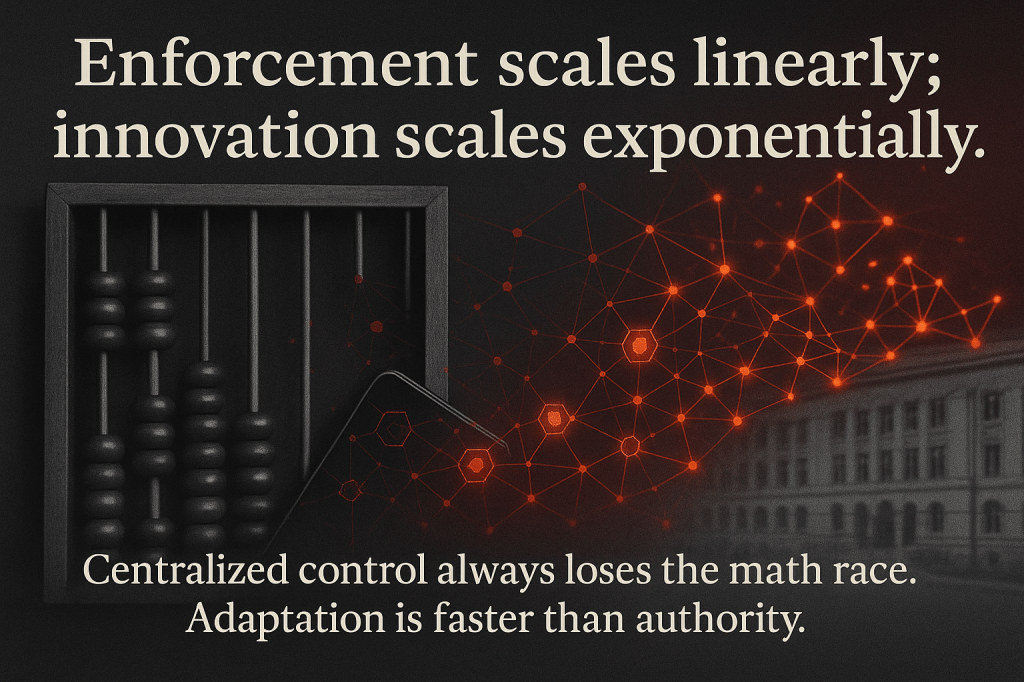
Enforcement scales linearly; innovation scales exponentially.

IV. Personal Anarchy: The Inner Ledger
Personal Anarchy is not rebellion—it’s hygiene.
The disciplined upkeep of one’s own sovereignty.
Competence is your defense.
Discretion is your camouflage.
Mobility is your insurance.
Reciprocity is your passport.
You don’t beg for freedom; you maintain it like muscle.
A sovereign individual doesn’t need permission—only practice.
Each encrypted message, each self-sufficient act, is a quiet vote for autonomy.
Enough of these, and coercion loses its audience.
Freedom is the discipline of optionality.
V. Adaptive Anarchy: How Order Scales Without Command
When many individuals operate by the same principles of voluntary order, the pattern scales naturally into Adaptive Anarchy—a social ecosystem, not a social contract.
It’s the marketplace that self-balances before regulators arrive.
The mesh network that stays online when governments pull the plug.
The protocol that outlasts the platform.
Its grammar is simple:
Modularity: Agreements are small and reversible.
Redundancy: Every failure is a lesson.
Reputation: Authority is earned and revocable.
Voluntarism: Participation is always elective.
Hierarchy demands obedience; adaptive order invites cooperation. Coordination is not the exception to human nature—it is the default. Command is the anomaly.

VI. The Engines of Decentralized Order
Two mechanisms keep this order alive and self-correcting: antifragility and nonviolent refusal.
Antifragility means the system grows stronger through shock. Each failure refines it; each crackdown forges a better workaround.
Every banned app spawns an alternative; every censorship campaign expands the market for truth.
Gene Sharp taught that power depends on obedience. Withdraw consent, and it starves. In the digital century, this withdrawal looks like encrypted communication, parallel economies, and strategic noncompliance.
Pressure makes hierarchies brittle—but it makes networks wise.
Overreach is the tax monopolies pay for ignoring reality.

VII. A Sketch of Civilization Without Thrones
The architecture of decentralized order is modest but effective:
1. Micro-contracts: Small, clear agreements that expire unless renewed.
2. Polycentric Arbitration: Competing dispute forums where justice is earned by track record, not title.
3. Reputation Markets: Trust becomes portable, measurable, and reversible.
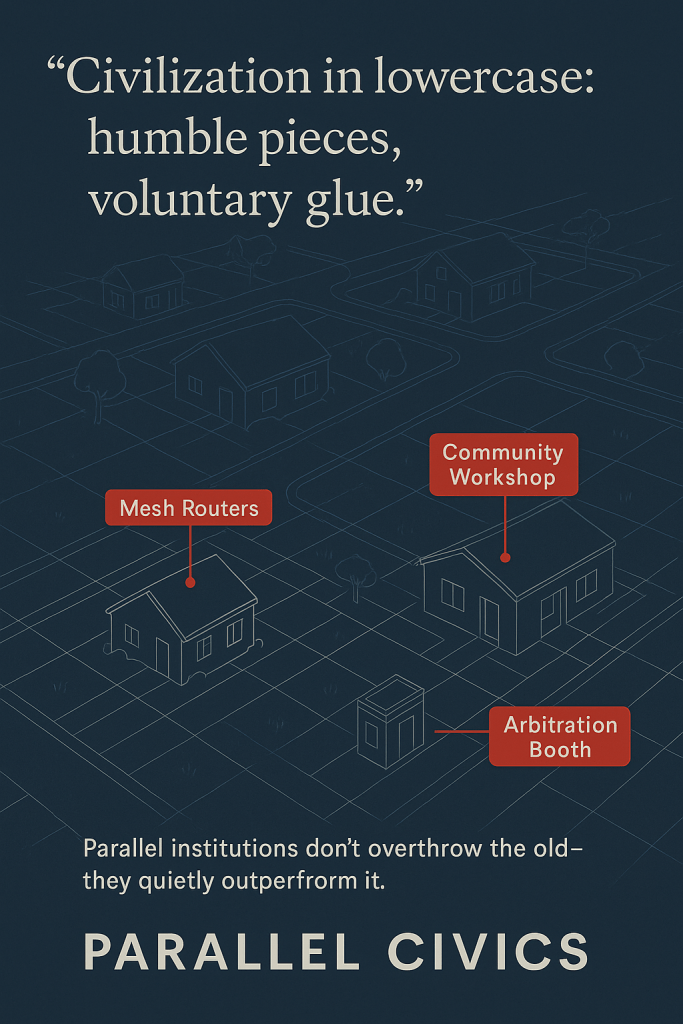
4. Parallel Utilities: Local mesh networks, community credit, co-op infrastructure.
5. Information Immunity: Redundant truth channels and anonymity for the vulnerable.
6. Privacy Defaults: Encryption as etiquette; minimal data as manners.
7. Exit Lanes: Every system designed to be left gracefully.
Each mechanism is humble on its own—but together, they form something formidable: civilization in lowercase.
VIII. Tensions, Not Denials
Decentralized order doesn’t mean utopia; it means reality acknowledged.
Freedom introduces friction.
Too much openness invites predators. Too much gatekeeping ossifies communities.
Too much diversity fragments; too much uniformity kills innovation.
The art is balance, not purity.
Design, not ideology, resolves these tensions:
Layered trust systems guard against bad actors.
Federated structures balance local autonomy with shared standards.
Redundancy absorbs shock.
Exit remains the ultimate audit.
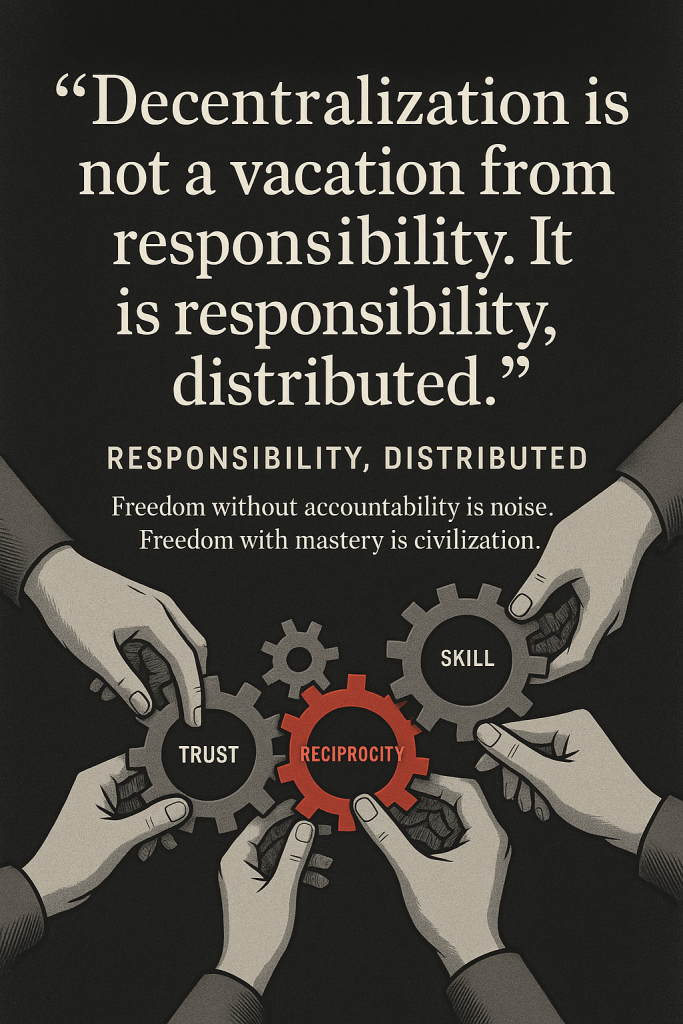
Decentralization isn’t an escape from responsibility—it’s responsibility, distributed.
IX. Practicing Order Without Permission
Don’t romanticize. Civilization is maintenance work.
Default to privacy, but not paranoia.
Keep promises short and feedback fast.
Teach one person what you’ve learned, and you double your reach.
Avoid idols—expertise should expire.
Use ridicule wisely: not to humiliate people, but to disinfect bad ideas.
Freedom scales only when it remains humane.
X. Order, Rediscovered
The most astonishing fact about human order is how little of it was designed.
Language evolved without planners.
Markets regulate themselves with invisible precision.
Science self-corrects faster than any ministry.
We cooperate by instinct, and bureaucratize by habit.
Our error was to confuse monopoly with order—to mistake obedience for harmony.
True order grows from consent, not control.
It’s what happens when trust compounds faster than fear.
Carry your portable constitution (PA).
Contribute to the federated commons (AA).
Treat coercion as a design flaw, not a moral necessity.
Make departure easy, promises clear, and truth testable.
Build institutions that can be left without drama and improved without ceremony.
Do this, and the empires of enforcement won’t fall—they’ll fade into irrelevance.
The next civilization won’t look like a capital. It’ll look like a protocol.
Legible enough to join. Light enough to leave.

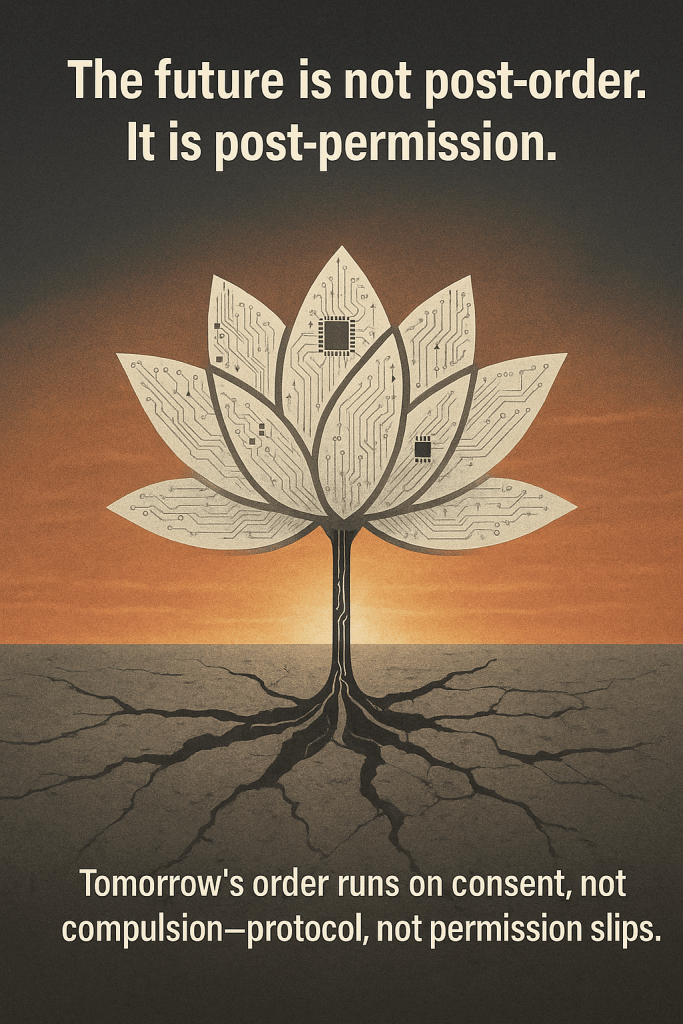
The future is not post-order. It is post-permission.
 Mental Self Defense